

For Dutch-speaking buyers, we also offer a complete guide in Dutch with the same detailed information, adapted to the Belgian and Dutch market.
In short: Buying a house on the Costa Blanca is a real opportunity in 2026, but it requires a good grasp of the Spanish procedures: NIE, arras contract, purchase costs of around 10 to 13.5% depending on the region and type of property. In this guide, you will find prices per m² by area, the steps of a secure purchase and the differences between the northern and southern Costa Blanca. Maison Costa Blanca, working with its partner Costa Blanca Sales (established since 2000), supports you at every step with proven local knowledge.
Buying a house in Spain is a dream project — guaranteed sunshine, an unrivalled quality of life, prices still affordable compared with Northern European markets. But for many foreign buyers, the administrative reality can quickly become an obstacle: language, taxation, notarial procedures, non-resident financing… All questions that deserve precise answers. At Maison Costa Blanca, we work with Costa Blanca Sales, active since 2000 on the southern Costa Blanca (Torrevieja, Orihuela Costa…) and in the Region of Murcia. We know every neighbourhood and every subtlety of the local market. This guide gives you everything you need to carry out your project with complete peace of mind.
To navigate these complex procedures without stress, the support of a local expert often proves decisive — our advisers guide you at every step and the independent lawyer we recommend checks the file to secure your transaction.
Why buy a house on the Costa Blanca in 2026?
The Costa Blanca has advantages that are hard to ignore: around 2,850 hours of sunshine a year (AEMET climate normals), a moderate cost of living, good-quality infrastructure and a well-established international community. In 2026, the market remains dynamic, driven by sustained demand from France, Belgium, the Netherlands and the United Kingdom.
Prices per m² vary considerably from one area to another, which means every type of buyer can find their place (indicative asking prices, source idealista, 2026):
- Torrevieja and Orihuela Costa (south): around €2,550/m² in Torrevieja (May 2026) and €2,990/m² in Orihuela Costa (January 2026) for apartments and villas in residential developments.
- Calpe (north): around €3,570/m² (June 2026), with strong demand for properties with sea views.
- Benidorm (north): around €3,730/m² (mid-2026), driven by a very active holiday rental market.
- Alicante city: around €2,720/m² on average (August 2026), with wide differences between neighbourhoods and a more urban and diverse market.
The market is tight in certain segments — villas with pools, seafront properties, recent builds — which makes it essential to act quickly. That is precisely why being supported by a local agent makes the difference.
In the south (Torrevieja, Orihuela Costa), you will find apartments and villas in residential developments: a wide range of properties to suit every budget and property project.
For buyers looking for high-end properties, the northern coastal areas offer the best opportunities. Discover our detailed guide to luxury property on the Costa Blanca to explore the premium areas and their specific features.
Northern vs southern Costa Blanca: which area should you choose?
Choosing between the north and south of the Costa Blanca depends above all on your lifestyle, your budget and your goals: main residence, second home or rental investment.
What is the difference between the northern and southern Costa Blanca when buying?
The northern Costa Blanca (Calpe, Altea, Jávea, Moraira) appeals to buyers looking for charm, authenticity and premium properties, with higher entry prices (from €300,000). The south (Torrevieja, Orihuela Costa) attracts a more varied range of buyers thanks to affordable prices from €120,000, large French- and Dutch-speaking communities, and excellent rental yields.
In practice: if you are looking for a peaceful second home overlooking the coves, head north. If you prioritise accessibility, the international community and a controlled budget, the south offers unbeatable value for money. Our teams know both areas in depth and can guide you according to your profile. Find out about our agency and what sets us apart in this market.
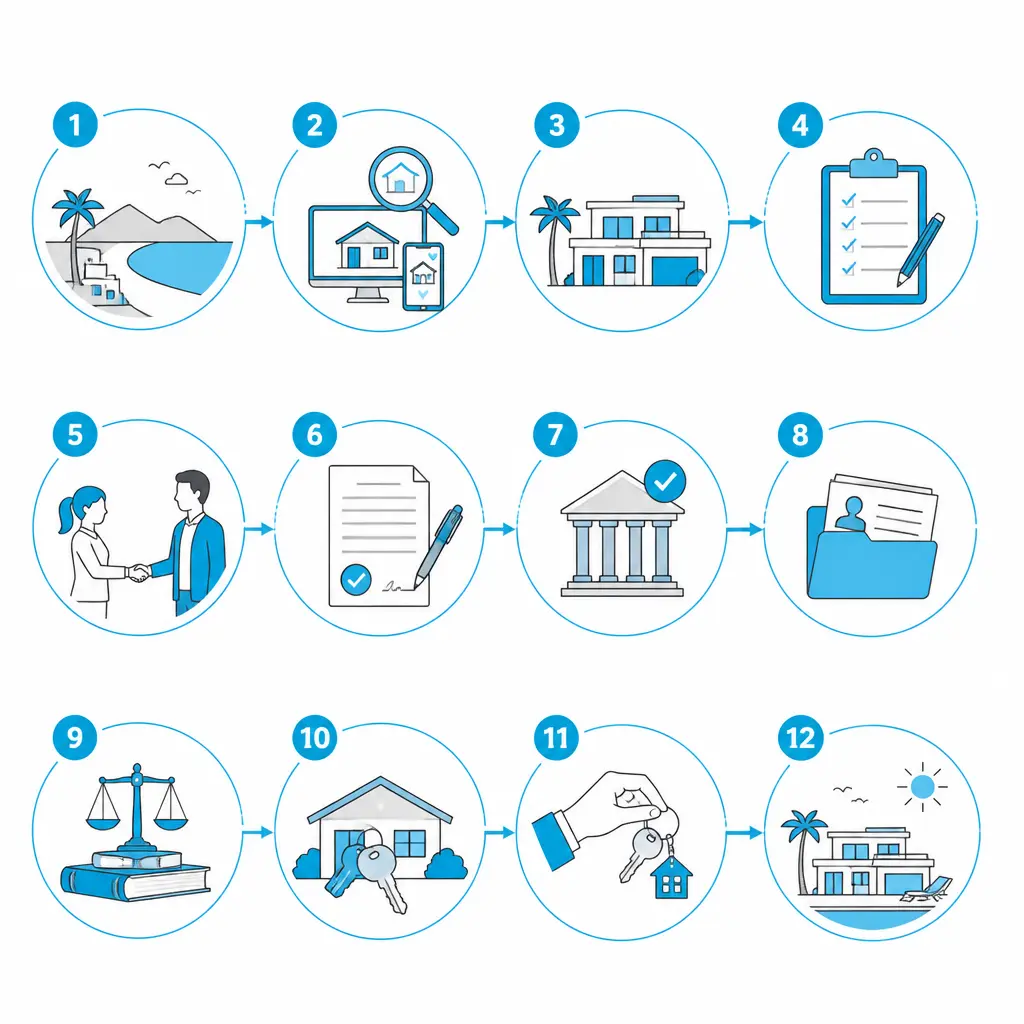
The key steps to buying a house in Spain as a non-resident
A property purchase in Spain follows a structured process. By understanding it from the outset, you avoid unpleasant surprises and gain confidence at every step.
- Step 1 — Set your overall budget: purchase price + purchase costs (around 10–13.5%) + any renovation work.
- Step 2 — Obtain your NIE: the identification number required for any legal transaction in Spain.
- Step 3 — Sign the offer and the contrato de arras: a deposit (usually 10% of the price) that secures the property for both parties.
- Step 4 — Legal due diligence: checking charges, debts, planning and permits. A critical step handled by the independent lawyer we recommend.
- Step 5 — Signing the notarial deed (Escritura): before a Spanish notary, in the presence of both parties. The title deed is then registered in the Land Registry (Registro de la Propiedad).
For more on each step, see our complete guide to buying in Spain, updated for 2026.
How do you obtain an NIE to buy a house in Spain as a non-resident?
The NIE (Número de Identidad de Extranjero) can be obtained either at the Spanish consulate in your country of residence, or directly in Spain from the National Police. There is no official processing time: in practice it ranges from the same day to several weeks, depending on appointment availability (cita previa) or the consulate. Documents required: form EX-15, a valid passport and proof of the reason for the application (a sales agreement is sufficient), plus payment of the fee (form 790, code 012: €9.84 in 2026).
Can you get a mortgage in Spain as a non-resident?
Yes, several Spanish banks (Sabadell, CaixaBank, Santander) lend to non-residents up to 60–70% of the lower of the price and the bank valuation (tasación). You will need to provide your last three payslips or financial statements, tax assessments, bank statements and proof of the property’s value. A local broker can make the process easier.
What are the real costs of buying property in Spain?
What real costs should you plan for when buying property in Spain?
For a resale property, allow for ITP (property transfer tax): 9% in the Valencian Community for deeds signed since 1 June 2026 (11% above €1,000,000) and 7.75% in the Region of Murcia. For a new build, it is VAT (IVA) at 10% + 1.4% stamp duty on legal documents (AJD) in the Valencian Community (1.5% in the Region of Murcia). Add notary fees, registration fees and agency fees. Overall budget to set aside: around 10.5 to 11.5% of the purchase price for a resale property and 12.5 to 13.5% for a new build in the Valencian Community (around 9.5 to 10.5% for a resale property in the Region of Murcia).
Here is a breakdown of the main cost items:
- ITP (resale property): 9% of the purchase price in the Valencian Community (deeds since 1 June 2026; 11% above €1,000,000), 7.75% in the Region of Murcia.
- VAT (new build): 10% + 1.4% Stamp Duty on Documented Legal Acts (AJD) in the Valencian Community (1.5% in the Region of Murcia).
- Notary fees: official sliding scale, around €700 to €1,000 for a €250,000 property.
- Registration in the Land Registry: around €400 to €700 for a €250,000 property.
- Agency fees: generally paid by the seller in Spain, but always check with your agent.
- Legal fees (lawyer): recommended, allow around 1% of the purchase price + VAT.
These figures are indicative. Our experts give you a personalised estimate at the first consultation. Contact our local experts to get a simulation tailored to your project.
Luxury homes on the Costa Blanca: a market in its own right
The Costa Blanca is home to a particularly dynamic premium segment. Villages such as Altea, Jávea and Moraira have a concentrated offer of architect-designed villas with infinity pools, panoramic Mediterranean views and high-end finishes.
Buyers of luxury homes on the Costa Blanca are mostly Dutch, Belgian, British and Scandinavian, looking for a prestigious second home or a European pied-à-terre. Entry prices in this segment start at around €600,000 and can exceed €3 million for seafront properties or contemporary villas with integrated home automation.
For high-value transactions, Maison Costa Blanca recommends an independent law firm, which checks the property before signing; for tax questions, consult a tax adviser. To explore these exceptional properties, read our blog or browse our premium listings.
Key takeaways
- Prices per m² range from around €2,550/m² in Torrevieja to around €3,730/m² in Benidorm (indicative asking prices, idealista, 2026): choosing the right area is decisive for your budget and goals.
- The NIE is mandatory before any purchase in Spain: apply for it at the consulate or locally as soon as you start your search.
- Budget around 10 to 13.5% of the purchase price to cover purchase costs (taxes, notary, registration, lawyer), depending on the region and type of property.
- Having the property checked by an independent lawyer before signing is the best way to secure a purchase in Spain.
Our expert view
In 2026, the buying window remains favourable on the Costa Blanca, particularly in the south (Orihuela Costa, Torrevieja), where prices are rising but still offer an accessible entry point with strong rental potential. For a first purchase abroad, we always recommend entrusting the legal due diligence to a local professional: a missing clause or a property encumbered with debt can turn a great project into a nightmare. Together with its partner Costa Blanca Sales, Maison Costa Blanca is the partner you can trust, from the first viewing to the handover of the keys.
Buying a house on the Costa Blanca is a concrete, achievable project that can be made secure — provided you have the right support. Whether you are looking for an apartment in Torrevieja, a villa with a pool in Calpe or a luxury home in Altea, Maison Costa Blanca puts its local expertise and command of Spanish procedures at your service. Contact our local experts today to discuss your project and access our listings of houses for sale on the Costa Blanca.
🧠 Quiz: test your knowledge
Which document is essential before signing any notarial deed for a property purchase in Spain?
Show the answer
The NIE (Número de Identidad de Extranjero) is mandatory for any property purchase in Spain. Without it, no notarial deed can be signed. It can be obtained at the Spanish consulate in your country or directly from the National Police in Spain.
Before finalising your purchase, find out the best time to visit Alicante: this will help you confirm your lifestyle choice and anticipate the real climate of your future region.